

250 years ago, America was founded on the principles of democracy, among them: freedom of religion and speech, citizenship, voting rights, minority rights, and most importantly, the right to life, liberty, and the pursuit of happiness as outlined in the Declaration of Independence. As America prepares to celebrate its past in 2026, author David Contosta’s newest book, The Survival of American Democracy: Presidential Abuse of Power and Reforms reminds us to look toward the country’s future and what needs to be done to ensure the American democracy continues to survive, and better yet, thrive.
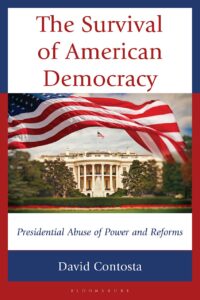 Contosta’s book, which explores the history and evolution of the presidency from the Founding Fathers to the present, offers a timely examination of threats to American democracy. Contosta analyzes everything from the cult of personality to unchecked executive war powers and partisan gridlock, as well as an overall examination of the history and sometimes problematic role of the Electoral College in deciding elections. His book examines the state of the country’s current political climate and addresses the once prescient warning of Benjamin Franklin, that America is “a republic, if you can keep it.”
Jeffrey Carroll, associate professor of political science and chair of the Center for Data & Society, calls the book a “work of bravery for the times,” sharing, “this thought-provoking and salient book accounts for various ways that executive power is exploited and in turn, results in inevitabilities that pose an existential threat to American democracy.”
For Contosta, who has taught history at Chestnut Hill College for over 50 years, this book marks his 27th overall, with previous works spanning multiple eras of history such as 1980’s Henry Adams and the American Experiment, 2008’s Rebel Giants: The Revolutionary Lives of Abraham Lincoln and Charles Darwin, and 2017’s America’s Needless Wars: Cautionary Tales of US Involvement in the Philippines, Vietnam, and Iraq. A renowned local historian, Contosta has also penned several books looking at Philadelphia history including1992’s Suburb in the City: Chestnut Hill, Philadelphia, 1850 – 1990 and 2003’s Plymouth and Whitemarsh Townships, PA (Images of America). His four-volume tome Metropolitan Paradise: The Struggle for Nature in the City, Philadelphia’s Wissahickon Valley, 1620 – 2020, co-authored with Carol Franklin in 2011, was the subject of the documentary On the Wissahickon, which Contosta wrote and produced in 2019.
“For many years, I have taught courses at Chestnut Hill College on the history of the American presidency,” notes Contosta on why now was the right time to pen this book. “One of the themes that I have addressed in them is the abuse of presidential powers, which then formed the corpus of this, my newest book. I believe this connection is an excellent example of the intersection of teaching, scholarship, and writing.”
Chestnut Hill College congratulates Dr. Contosta on The Survival of American Democracy, yet another timely and relevant offering to the American historical zeitgeist.
-Marilee Gallagher 2014